The plague would later come to be known as Starcrystal DiseaseStarcrystal Disease — A cosmic plague brought by a meteorite; it assimilates flesh and consumes the soul.—a cosmic contagion brought to the world by a meteorite.
It assimilated flesh, consumed the soul, and could even spread into inorganic matter. The meteorite itself had fallen in the great desert of the southern continent, within the territory of the Southern Confederation. At the time, the disease was still considered incurable.
After conducting an initial investigation, Eden used the influence of the Continental AcademyContinental Academy — Eden sat on its standing council from the age of eighteen. to secure both authorization and funding from the Confederation. She then organized the construction of a forward outpost dedicated to containing and combating the plague: New GrandonNew Grandon — The forward outpost Eden built to fight the plague..
And this is where the story begins.
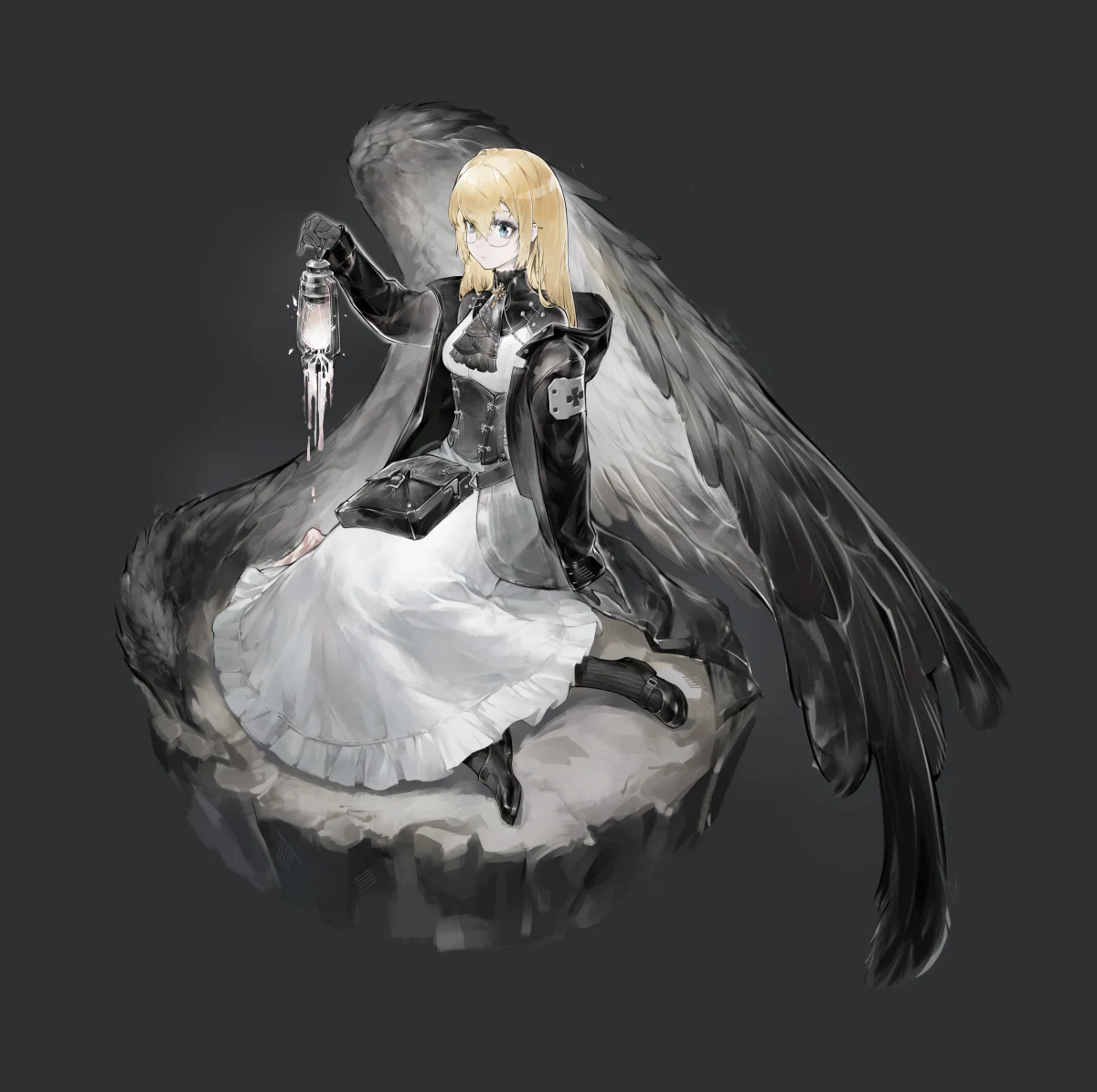
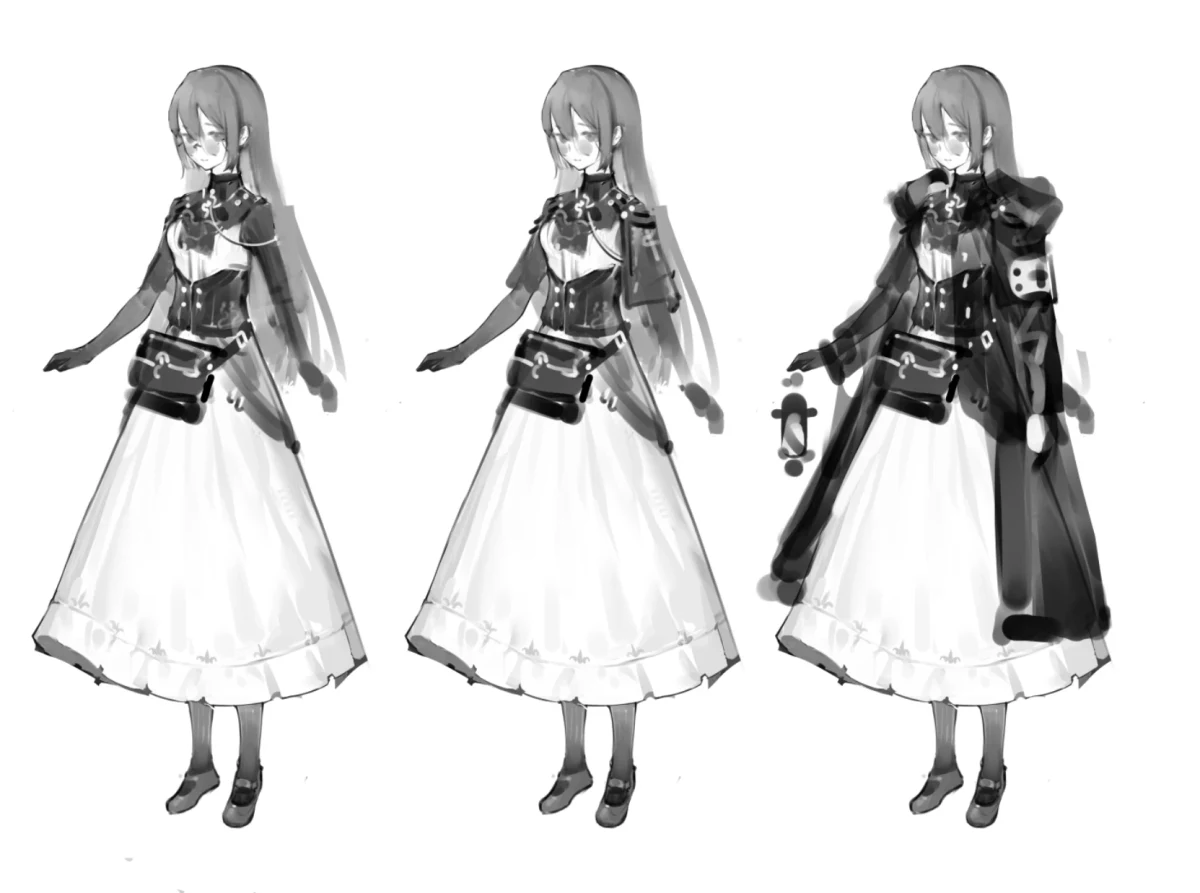
Three years later, the first drug developed to treat Starcrystal Disease entered clinical trials. Vivian BeninVivian Benin — Eden’s patient, one of the first subjects of the new drug’s trial., one of Eden’s patients, was among those selected to receive the experimental treatment.
“I have starcrystal disease. The latent form, with very severe side effects…” She spoke evenly to her reflection in the glass: a bald, hollow-eyed stranger. Something seemed to occur to her, and she paused. “No. It’s the treatment that has very severe side effects.”
“I have stage-four starcrystal disease. Widespread metastases. There is no stage five.” She looked out at the street, and beyond it at the land eaten away by the plague. Her voice was just as calm. “And I have to be very strong. It’s the only way I can endure eight consecutive cycles of combination therapy. This is of great importance in the search for a definitive cure for starcrystal disease…”
“Go on. Give me the full dose.” She turned her back on the world beyond the window and stared, a little numbly, at the IV stand and the glass bottle hanging from it. Inside was a medicine she had never seen before. She watched the unknown liquid make its slow way down the rubber tube and into her body—a body called Vivian Benning. “Give me the full dose.”
The new drug prolonged patients’ survival and slowed the progression of the disease, but it could not offer a true cure. In doing so, it also prolonged the suffering of those it kept alive.
Eden thus found herself caught in the same conflict and moral dilemma that Luo ZeLuo Ze — Leader of a Doctors Without Borders team; Eden’s adoptive father and teacher. had once faced. Only then did she truly come to understand the burden her father had carried.
You want to lower the dose. Stop the trial. You feel for her, and for all the patients suffering from the side effects, all those who have suffered them before. And you blame yourself for failing in your duty: to care for the sick, to ease their suffering. Ending the trial is impossible. You have the authority to do it. But you cannot bring yourself to, Eden.
Stop the trial, then. Go and tell the patients yourself: the new drug has failed. You’re all done for. Lie there in your beds and wait to die.
Do you dare?
By her fourth year in the epidemic zone, years of overwork and the relentless strain of moral conflict had pushed Eden to the brink of psychological collapse.
After an all-night conversation with one of her patients, she made a decision: she would travel to the site where the meteorite had fallen and conduct a field expedition there, hoping to recover an original sample of the contagion and achieve the breakthrough their research desperately needed.
“For example, you can choose ‘full resuscitation.’ If your heart stops, we’ll do everything we can to keep you alive and take you to intensive care until your condition is stable. Or you can choose ‘do not resuscitate.’ If your heart stops, then… we let it go.”
“You can take some time to think about it. I just… wanted you to know you have these two choices. Before anyone else talks to you about them.”
Benning went on eating her ice pop. Only when the sweetness had melted away on the tip of her tongue did she ask, “Would they object?”
“No. But they’ll lean toward keeping you alive. As long as your life can be prolonged, that’s what matters, however many machines you’re already attached to.”
“And you?”
Eden lowered her head and looked at her motionless legs. “I don’t know. My father saved my life when I was little. The price was that I might never stand again. I’ve been bitter about it, too. I’ve had my doubts. Wondered why my life had to be prolonged.”
“You’ll understand.”
“Thank you.” Benning saw the tears gathering at the corners of Eden’s eyes.
“You won’t object to my decision?”
Eden shook her head.
“Then that’s all right.” Benning lifted her gaze to the ceiling, familiar and strange at once. There was an apparition she had not seen in a long time. Across the dim ceiling, its hideous figure twisted into countless shapes of terror, giving one cold chuckle after another. This was the face of death. This was Death, whom nothing could resist. The harder you tried to flee Him, the closer He pursued you; the more you yearned for life, the more He pinned you to the earth to watch you suffer. For the first time in a long while, she smiled—at Death, standing before her.
“Let it go.” Her laughter came freely now. At last she had laid her burden down. She would no longer run from that terrible apparition. For she could see it now for what it was: nothing but the hollow left when the radiance of life was obscured.
What are you, after all? Only a slave to fate, to chance, to kings and desperate men, keeping company with poison, war, and sickness. Some may call you mighty. Some may call you dreadful. But you are neither. You are rest without end, an unbroken sleep. Yet even the poppy, or the charms whispered before sleep, can offer gentler solace than your touch. What reason have you, then, to be proud?
The expedition was one that bordered on a death wish, and at the same time an act of devotion. With such feelings in her heart, she set foot upon the plateau where the meteorite had fallen, only to be tormented in turn by the malice lurking within the plague.
Her own body was nearing collapse. Her patients were slipping toward death. And yet, in the depths of that overwhelming despair, she lifted up the light within her heart—a bloodstained hope.
Holy Sonnets 10
Death, be not proud, though some have called theeMighty and dreadful, for thou art not so;For those whom thou think'st thou dost overthrowDie not, poor Death, nor yet canst thou kill me.From rest and sleep, which but thy pictures be,Much pleasure; then from thee much more must flow,And soonest our best men with thee do go,Rest of their bones, and soul's delivery.Thou art slave to fate, chance, kings, and desperate men,And dost with poison, war, and sickness dwell,And poppy or charms can make us sleep as wellAnd better than thy stroke; why swell'st thou then?One short sleep past, we wake eternallyAnd death shall be no more, Death, thou shalt die.
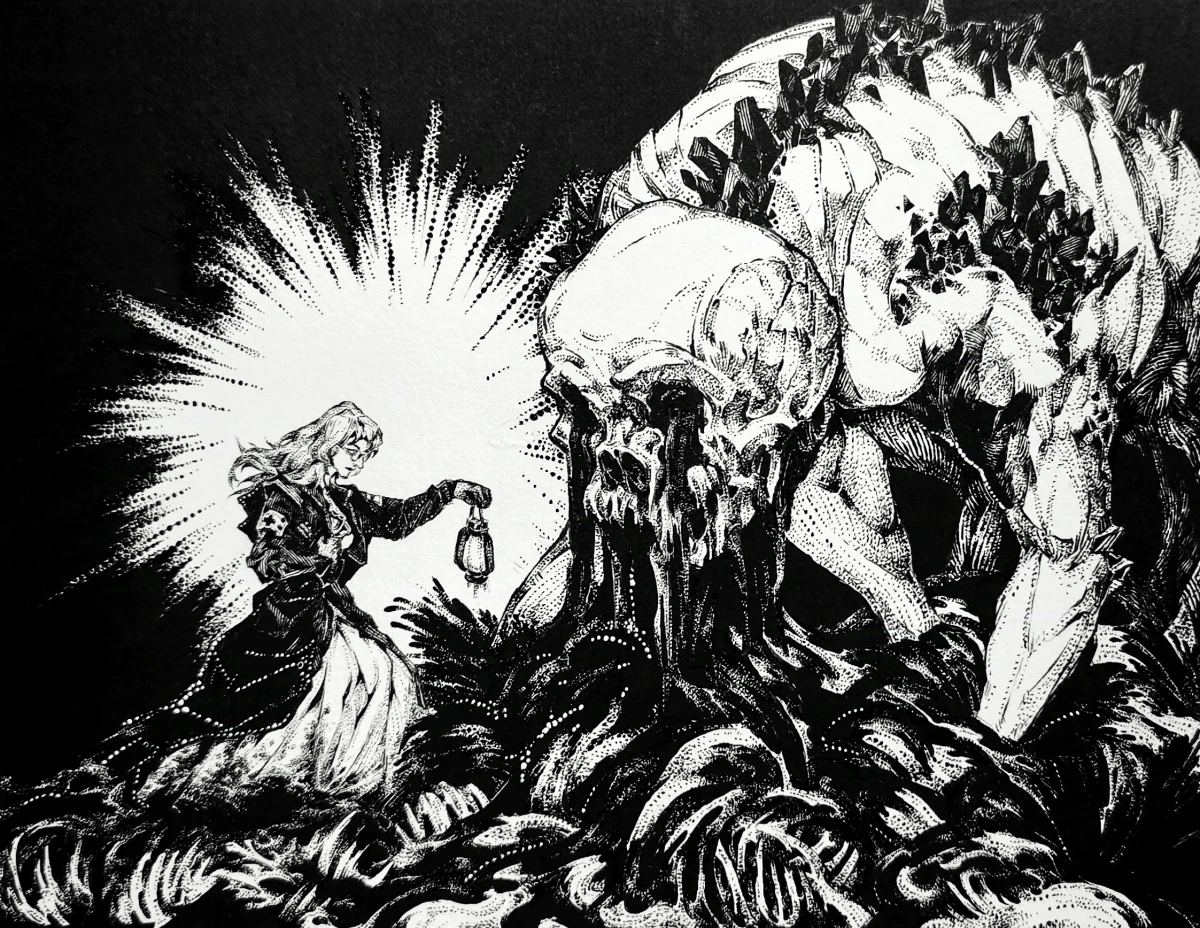
In the end, the plague consumed her.
But she did succeed in sending the sample back, and from it came the cure.
And at the very end of it all, she became that star.
Eden opened her eyes.
A vast crystal filled her vision. Her hand had almost reached it. Her mask was gone; her gloves lay discarded behind her. She had almost touched active starcrystal with nothing to protect her. She had almost been consumed.
And the crystal shuddered, as though in anger.
No—not only anger. She could see fine threads drifting through the air. It was calling something to it.
She soon learned what.
First, the ground trembled. Sand and stones began to shake. Something immense was on the move. Then a black line appeared along the top of the cliff. It spilled over the edge and plunged, like a great waterfall sprung suddenly into being, pouring black, befouled water into the crater. The black tide struck the ground and shattered. Still it came on. It gathered again, lengthening, thickening. As it drew nearer, she could finally make it out—not water, but creatures infected with starcrystal. Answering the core’s call, they came in a vast, headlong rush. Their bodies were no longer whole. They ran with nothing held back, their flesh breaking apart as they came. A creature at the front of the wave fell, and the beasts behind it trampled its carcass without mercy.
The crest rose higher and higher.
Even the sky was blotted out.
Too late now, she thought, with bitter self-mockery.
Fate was playful like that, fond of jokes without knowing how cruel they were. When you wished for death, it would not let you die; when you changed your mind and began to long for life, it laid a fatal trap with no way out.
What, then, could she still do? She turned, searching for the mercenaries. Time in dreams was always brief. She looked toward the opposite cliff and saw a few figures descending.
There was still time.
God, watch over me. Before my life is over, let me save a few more.
She bowed her head and laid her hand upon her chest.
There, a heart burned fiercely.
She could not tear herself open. She could only let herself burn with it. Eden looked proudly at the crystal. She knew she had already won.
But to thwart its designs, she had one thing left to do.
Then a pure white light rose.
From the depths of the valley to the vastness of the heavens.
So slender a pillar—unseen from afar.
So mighty a pillar—rising in human hearts.
The pure white light lifted the mercenaries and carried Eden’s words to them.
“Go. Go—take this light with you. Go.”
Fire burned once more
upon that dead land.
At the end of her life, before the tide swallowed her, she chose to give all she had to healing.
The light flared into flame,
and those twisted creatures could at last find rest.
Her ribs broke. Splinters pierced her lungs, and blood welled into her airways. She tried to draw one last breath, but choked on her own blood, coughing violently, bringing up a little scarlet froth. Her cooling body felt one last trace of warmth. All that remained in her fading sight was crimson. Her blood. The blood pouring from her chest. Only moments before, it had been boiling, burning. Now, at last, it warmed her own body too.
And still she would not close her eyes and quietly accept death—accept being torn apart and eaten by the monsters.
At least let her hold on until the final moment.
Let her have this last act of defiance.
Until blackness covered the world,
and even pain began to drain away.
My thoughts are impossibly slow. I am about to lose everything.
Her father had advanced reforms in anatomy and in the prevention and control of infectious disease.
Her people were working to free the scholars imprisoned by the Empire.
The mercenaries with her could carry the vital samples back to Granton.
And what have you done?
She thought of her father, a man from the East who never spoke of death, though it was never far from his side. Death was a heartless master. It had taken away the one she leaned on and left her behind, the proof that he had lived, to go on alone. Perhaps his death had not been such a hurried ending after all. Perhaps he had felt the same warmth she felt now. Perhaps… he, too, had longed for release.
I should say—
Death.
For most, a terror;
for a few, release;
for all, the end.
Where does your strength come from?
—My strength.
What strength did she have?
A lamp. A flame.
The fierce warmth of the mercenaries’ rough laughter.
Korich’s hand resting on her shoulder.
Two lonely souls sharing ice pops in the deep of night.
She was not left with nothing.
Then what is your “answer”? Can it really be “I’m not sure”?
No. How could she be uncertain? She could see that pitiful emptiness now, and all that was simply the way of things. Her strength had never been her own. It was the strength that held aloft the hopes of others—a sail lifted by a great wind, a banner borne high by the crowd.
—the final shroud that brings peace to the dead.
This was her heart’s answer. She would trust her heart.
She had never expected any god to answer her prayers.
Not even now.
Not even in dreams.
People will save themselves.
Even as you fall into hell, hold your head high;
even as you sink into the void, burn bright.
She saw the airship’s wings sweep across the sky.
She whispered her farewell to Granton.
She felt the last of her strength ebb away.
In the final instant before her consciousness dissolved, she felt one warm drop run down her face.
Then a second. A third…
Like a gentle rain—
so long overdue.